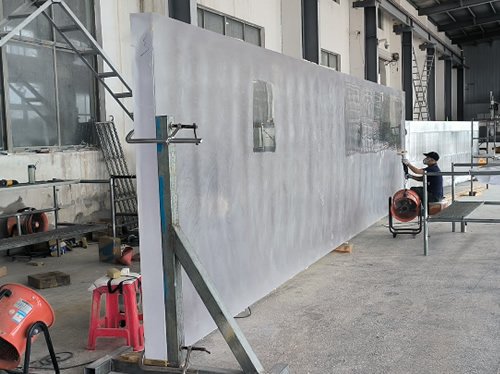
150mm Thick Oversized Clear Acrylic Sheet: The Technical Guide to a 12-Meter Villa Aquar...
Time:2026 - 28 -September , 5:17 pm
1. Product Overview
This article examines a 150 mm-thick, 12-meter-long, 2-meter-high high-transparency cast acrylic (PMMA) panel used as the viewing window of a private villa’s oversized home aquarium. Produced by monolithic casting and finished by multi-sided flame polishing, the panel delivers light transmission above 92% and safely withstands the hydrostatic pressure of a 2-meter water column. It is one of the largest clear load-bearing acrylic structures ever installed in a private residence.
Key Specifications:
Parameter
Value
Notes
Thickness
150 mm
Ample safety margin for 2 m water depth
Length
12,000 mm (12 m)
Single monolithic panel, minimal seams
Height
2,000 mm (2 m)
Matches design water depth
Light transmittance
≥ 92%
Optical-glass grade
Density
1.19 g/cm³
~ half that of glass
Impact strength
12–16× ordinary glass
Safe, non-brittle
Service temperature
−40°C to +80°C
Stable indoors
2. Why Acrylic, Not Glass, for a Villa Aquarium?
2.1 The Physical Limits of Glass at Oversized Sizes
Float or low-iron glass is typically limited to roughly 3.3 m × 6 m per pane. A 12-meter viewing window would require multiple glass panes joined together — introducing visible seams and breaking sightlines. Worse, glass is brittle: at 2 m depth, hydrostatic pressure reaches ~19.6 kPa (≈2 tonnes/m²). A 150 mm glass pane would weigh roughly 450 kg/m² and risks catastrophic breakage under localized stress — unacceptable in a home.
2.2 Acrylic vs. Glass at a Glance
Criteria
Low-Iron Glass
Cast Acrylic (PMMA)
Max single pane
~3.3 m × 6 m
12 m × 3 m and beyond
Weight at 150 mm
~450 kg/m²
~179 kg/m²
Impact resistance
Low, brittle
12–16× glass
Heat bending
Not possible
Can be curved
Seam visibility
Visible joints
Solvent-welded, nearly invisible
Repairability
Must replace whole pane
Polish out scratches
Yellowing over time
None
Quality imported stock: minimal over 30 yrs
Bottom line: Once a viewing window exceeds 6 m in length or 1.5 m in water depth, acrylic is virtually the only viable material.
3. Is 150 mm Thick Enough for 2 Meters of Water?
3.1 Hydrostatic Pressure Calculation
Lateral water pressure on a vertical wall increases linearly with depth:
P = ρgh
ρ = 1000 kg/m³, g = 9.8 m/s², h = depth (m)
Surface (h=0): 0 kPa
1 m depth: 9.8 kPa
Bottom (h=2 m): 19.6 kPa ≈ 2.0 tonnes/m²
The total horizontal thrust on the 12 m × 2 m wall:
F = average pressure × area = 9.8 kPa × 24 m² ≈ 235 kN (~24 tonnes)
3.2 Why 150 mm? The Engineering Rule of Thumb
PMMA has a modulus of elasticity of about 3.0 GPa and an allowable bending stress of roughly 25–30 MPa. Industry practice for aquarium acrylic thickness uses:
Thickness t (mm) ≈ Design depth H (m) × empirical factor K
For a 2 m depth, K typically ranges from 60 to 80, giving:
t ≈ 2 × 75 = 150 mm
This figure balances structural safety, long-term creep deflection, and cost.
Important: Acrylic creeps over decades. Designing for short-term strength alone is unsafe. The 150 mm thickness is back-calculated to keep long-term deflection below span/250 over a 20–30 year service life.
4. A 12-Meter Seamless Panel: How Is It Made?
4.1 Cast vs. Extruded Acrylic
Two processes dominate acrylic sheet production:
Extruded acrylic: limited sheet size, higher internal stress — unsuitable for deep aquariums.
Cast acrylic: polymerized in custom molds, high molecular weight, low residual stress, and capable of enormous dimensions.
The 12 m × 2 m × 0.15 m panel in this project is a monolithic casting requiring a purpose-built steel mold. Material volume:
Volume = 12 × 2 × 0.15 = 3.6 m³
Weight = 3.6 × 1.19 ≈ 4.3 tonnes
4.2 Seamless Solvent Welding for Longer Spans
When an even longer run is required (15 m, 20 m), panels are joined using solvent cementing:
Mating faces milled flat to within 0.02 mm.
Chloroform- or dichloromethane-based solvent injected into the joint.
Surface molecules interdiffuse, fusing the two panels at molecular level.
Cured joint reaches 85%+ of parent strength, with near-identical optical clarity.
Professional aquarium fabricators can achieve joints that are invisible from 3 meters away.
5. Optical Clarity: The Point Is to Not See the Glass
Acrylic’s optical properties are why it dominates public and residential aquarium design:
Refractive index 1.49, close to water (1.33), minimizing refraction distortion when viewing through the water line.
No birefringence: cast sheet is optically uniform — fish look undistorted.
Flame-polished edges: edge polishing produces a crystal-clear, non-frosted rim.
The villa aquarium experience is about immersion — the homeowner sits in the living room and fish appear to float in mid-air. Any visible seam, haze, or color cast breaks that illusion.
6. Typical Villa Applications
Full living-room feature wall: The 12 m × 2 m panel replaces a media wall and becomes the social center of the home.
Basement wine-cellar / lounge water wall: Paired with coral reef scaping to create a private seven-star lounge.
Double-height atrium side window: Embedded between floors, visible from both levels.
Dining-room / kitchen partition tank: Replaces a glass divider with a living mural.
Grand foyer centerpiece: The first visual impression on entry.
25–50 t crane; reserve a lifting opening in the villa
8
Sealing into concrete/steel channel
Aquarium-grade sealant, dual water-stop
9
Flood testing
Fill in 3 stages (1/3 → 2/3 → full), hold 72 hours
10
Cycling & fish introduction
Wait for ammonia/nitrite cycle before stocking
8. Care and FAQs
8.1 Cleaning
Wipe with a soft microfiber cloth + clean water or dedicated acrylic cleaner. Never use alcohol, acetone, or benzene-based solvents — they cause stress cracking.
Remove limescale with diluted white vinegar; never scrape with blades.
Minor scratches can be wet-sanded (2000# → 3000#) and polished out.
8.2 Long-Term Care
Avoid direct sunlight; add shading or UV filtration to slow aging.
Inspect seals and panel deflection annually.
Maintain water temperature at 24–28°C and avoid rapid swings.
9. Frequently Asked Questions
Q1: Is 150 mm acrylic safe for a 2 m-deep aquarium?
A: Yes. Using the industry rule t ≈ H × 75, a 2 m depth calls for 150 mm, and long-term creep is already factored in. Reputable fabricators provide third-party structural calculations and a 20-year warranty.
Q2: Can a 12-meter panel actually be delivered to a villa?
A: Yes, but logistics must be planned early. The 4.3 t panel travels upright on a 13 m+ flatbed truck. The villa needs a lifting path (typically ≥ 3 m wide, ≥ 2.5 m tall) and a 25–50 t crane on site.
Q3: How long does an acrylic aquarium last? Will it yellow?
A: Cast acrylic made from virgin premium resin (e.g., Evonik, Lucite) will show minimal yellowing over 20–30 years indoors. Recycled-content panels may yellow within 3–5 years. Always request the resin manufacturer’s certificate.
Q4: Is acrylic more expensive than glass?
A: Per square meter, yes. But at these sizes and depths, glass is not a feasible alternative. Turnkey acrylic installations typically range from tens of thousands to over a hundred thousand RMB per square meter, depending on thickness, curves, and custom shaping.
Q5: What if the panel gets scratched later?
A: Acrylic can be refinished on site. Scratches shallower than 1/10 of panel thickness can be sanded and flame-polished back to optical clarity — something glass cannot offer.
10. Conclusion
A 150 mm × 12 m × 2 m high-clarity cast acrylic panel is not merely “a thick plastic sheet” — it is a precision-engineered transparent load-bearing structure. Its five decisive advantages — castability at enormous scale, 92% light transmission, 12–16× the impact resistance of glass, invisible solvent joints, and on-site repairability — make it irreplaceable for villa-scale residential aquariums.
If you are planning a feature-wall tank, atrium viewing window, or commercial lobby aquarium, engage a specialist acrylic aquarium manufacturer early on structural calculations, transport routing, and lifting logistics — these three factors determine whether the project can be built at all.